Monday, October 5, 2026

- Your Library
- Connect
- Events & Programs
- Read, Learn & Explore
While there are varying opinions about Artificial Intelligence (AI), its presence around us can’t be denied. As AI becomes more prevalent in our community, many of us have questions about how it’s used and why its use can be controversial.
Paul Freeman is the Library’s 2026 Creative in Residence as the first AI Collaborative Artist. During his residency, Paul will share his process of using AI in artwork and how it can make us look at art in a different light.
He compares using AI in his artistic practice to a sailor using the wind to get to their destination.
“You can use the wind to get somewhere even though it doesn’t care where you end up. When working with AI, you can work with it, but can’t let it convince you into thinking it has any kind of investment in your outcome,” explains Paul.
As an artist, Paul has never shied away from controversy or outside of the box thinking.
Paul started learning about jewelry making at Alberta University of the Arts before focusing on interdisciplinary studies. From there, his practice grew into an exploration of the natural world — specifically the creatures and things we overlook, discard, or turn away from.
His work draws on something most of us felt as children — a genuine love for all living things before we learned what was acceptable to care about. Using a colour copier to photograph and arrange specimens from nature — including dead animals found on roadsides and in fields — he gives careful attention to what most of us would rather not look at.
“The work is about the things we look away from — what gets called ugly or is cast aside. I want to recontextualize that: to look right at it and put it in a light where it can be seen and even loved.”
Paul also creates sculptures, jewelry, and illustrations. In whatever he’s creating, he enjoys feeling challenged and trying new things as an artist.
Paul first came across AI in art while watching a segment on Last Week Tonight with John Oliver. Stable Diffusion, a generative AI technology software, was being used to make jokes about the late-night talk show host.
He was immediately intrigued by the potential of using AI in artwork. Paul’s method grew into what he calls “recursive regeneration” — feeding images into the software over and over again, selecting and evolving what emerges at each pass. It’s a methodology he’s been developing since the 1990s, when he used a colour photocopier to expand images to room scale. The AI arrived and slotted into a practice that was already built around growth and selection.
Paul acknowledges that there are valid concerns with using AI in artwork and doesn’t dismiss that theft can be involved in building the models.
"I know it's contentious, but every artist I know absorbs everything they've ever seen and stores it away. They're happy to pull it out whenever they need it because they're trying to make something. I thought that with using AI, it was really fun and interesting to see what could happen if you went fishing in this kind of collected unconscious.”
The collaboration with AI will never be the same as working alongside another person. Paul says it’s integral to take a human-centred approach when using AI.
“I think it is a real problem when we think it can do anything for us. It becomes exciting and interesting if we can figure out the ways that it can help us do the things that we really want to be doing — that's the way to maybe bring AI into our collective future.”
Paul is thrilled to find inspiration during his residency at the Library and to share what he has learned about AI as a collaborative tool. He expects to connect with people who have varying opinions and understandings of AI. He will share the processes of using AI in art and will help others learn how they can reconceptualize the way they use it.
He will also share pieces of art that he has created using AI as a collaborative tool. The artwork is extremely detailed — approximately one billion pixels within each piece, roughly 500 times more detail than a standard computer monitor.
“I've shown this work a couple times to a few small groups of people. This is my chance to show (more) people what I've been up to. I'm excited about that.”
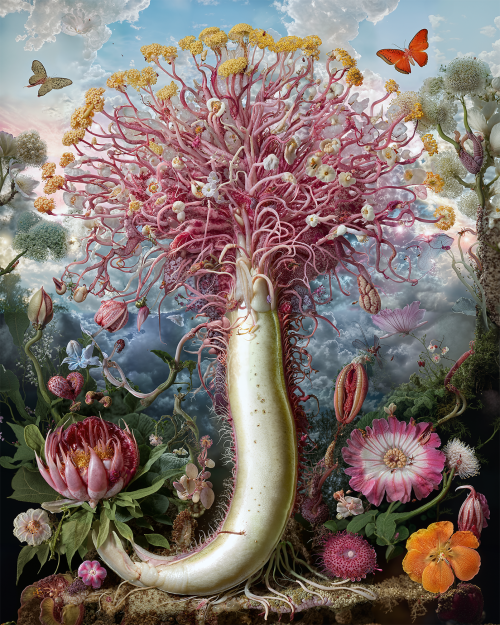
Soul Tree Reborn, AIC Art by 2026 Creative in Residence, Paul Freeman
There are seven residencies at Calgary Public Library throughout the year. The Creative in Residence allows different types of creative professionals to share their expertise with Library visitors, including knowledge that is often otherwise underrepresented in our communities.
Monday, October 5, 2026


Monday, October 5, 2026
Wednesday, September 16, 2026