Wednesday, September 16, 2026

- Your Library
- Connect
- Events & Programs
- Read, Learn & Explore
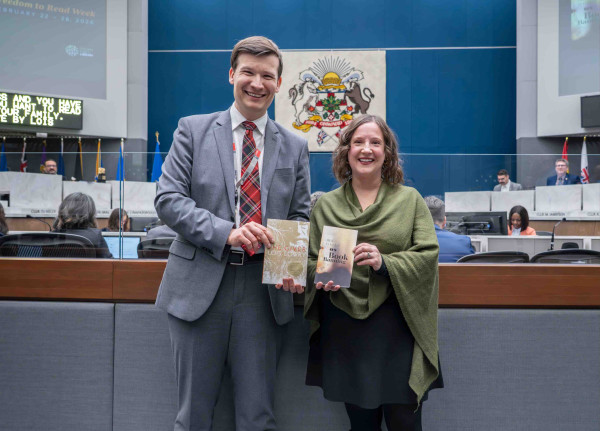
Freedom to Read Week officially kicks off on February 22 across the country. This annual event encourages Canadians to think about and reaffirm their commitment to intellectual freedom. On Tuesday, February 17, Calgary Public Library CEO Sarah Meilleur attended City Council to spread the word and share more about why this matters more than ever.
Good morning, everyone.
Thank you, Mayor Farkas and Council for having me here today.
I’m here on behalf of the more than 815-thousand Calgary Public Library members, our staff, our Board, and volunteers.
And I’m here today so we can celebrate our Freedom to Read together.
At Calgary Public Library, we have an obligation to protect your right to read and we have a professional responsibility to provide you...and all Calgarians...with the resources, tools, and spaces to access information freely while respecting your choice and privacy.
Now, why does this matter? Well, the right to access information and to freely explore ideas without fear or restriction is outlined in the Charter of Rights and Freedoms as a basic right for all Canadians.
And we are at a moment in time when the Freedom to Read is being challenged across North America. Over the last five years, there has been a drastic increase in challenges to intellectual freedom, from both sides of the political spectrum, across North America, and the world. There have been more than 800 book challenges in Canada in the last five years...with 120 of those coming in 2025.
So for a moment... imagine a world where your access to information and ideas is denied and your right to have difficult conversations is silenced.
Censorship shuts down stories and ideas. It erases perspectives and experiences. And when that happens, entire points of view lose the chance to be explored, considered, and understood. A censored world weakens our collective ability to learn from one another and build a better tomorrow together.
The Freedom to Read matters, and we have to stand up to censorship.
And let me be clear. Having the Freedom to Read doesn’t mean you have to agree with everything.
The public library's role is not to tell you what to read. We are here to ensure you have the ability to make the choice that is right for YOU.
Next week...February 22 to 28...is Freedom to Read Week. This week is an opportunity to celebrate and highlight every individual's right to access information. To learn and consider new ideas and to express your own thoughts, opinions,and feelings.
Every year I come to council to celebrate our Freedom to Read together. And I often present you with a book that has been challenged or banned. What you might not realize is that even groups who are often opposed on ideologies will call for the same item to be removed from libraries, but for different reasons.
Today, Mayor Farkas, I bring you two books and the first highlights just that.
The Giver by Lois Lowry has been challenged on both sides of the political spectrum. This dystopian novel written for teens, follows a 12-year old who lives in a community devoid of pain, colour, and emotional depth.
The Giver has been challenged for descriptions of euthanasia and eugenics ...that were thought too sensitive for teens... and also challenged for what might be considered anti-religious views. It has been challenged for descriptions of a teenager's dreams that include early awakenings of attraction and also for depicting familial structures outside of what might be considered traditional.
The Giver has been challenged for many reasons, and yet it continues to be a book on the curriculum because of the conversations it elicits. The Giver focuses on what choices youth should have about who they want to be, what they want to do, and the world they want to live in. This is a book about self-discovery, about what is important, and about the freedom to choose.
I want to share a quote from the author, Lois Lowry.
“Any time there is an attempt to ban a book, you should fight it as hard as you can. It’s okay for a parent to say, ‘I don’t want my child to read this book.’ But it is not okay for anyone to try to make that decision for other people.”
Freedom. Access. Choice.
You have the right to intellectual freedom.
Your Library provides you access.
You can choose what you read for yourself and your family.
This year I’m bringing you a second book. It hasn’t been challenged but as conversations about censorship increase, I wanted to bring you a resource that shares more about the history and impacts of censorship.
On Book Banning: Or How the New Censorship Consensus Trivializes Art and Undermines Democracy is written by Alberta-born Ira Wells. It discusses how book bans and challenges come about, how they come from both sides of the political spectrum, and the impacts that censorship has on society. It is a quick read, and an important survey of censorship from ancient Rome to present day, highlighting landmark legal cases, literary controversies, and philosophical arguments. And it makes you think. Which is the point.
Both these books make you think, consider, and ask questions. And that’s one of the most beautiful things about books.
When you were elected the Library gave each of you a copy of If you were a City by Kyo Maclear. I firmly believe that everything you ever needed to know can be found in a picture book — and this felt fitting to inspire you as you make decisions about the city you want to build, for today, and for future generations.
Mayor Farkas, Councillors, and City Administration...today I’m adding two more books to your reading list. I encourage you to think about that city you envision for the future, and to consider the impacts of censorship. And I invite you to join Calgary Public Library today and every day in our commitment to intellectual freedom and the Freedom to Read.
Wednesday, September 16, 2026
Wednesday, September 2, 2026
Wednesday, August 26, 2026